CAT KIDNEY DISEASE    | COMMON CAT HEALTH ISSUES | CAT BEHAVIOR   

Sponsored

Sunday, October 18, 2009

Persian Cats Health Issues

Lately, I have noticed that my male Persian cat has a problem with watery eyes. One of his eye starts to tear. There is a slight mucus like liquid that gathers around his eye.

A quick trip to the vet and I found out that this is one of the more common health issues that afflict the Persian cat.

I found the article below helpful in understanding issues that might affect my Persian cat. An informed pet owner is a good pet owner!

Persian Kittens


Persian Cats - Health Issues
By Frank Will

Persian Cats are by far and away the most popular breed, but there are some very common health problems and a few special nutritional needs required for this magnificent cat.

The breeding habits of some non reputable breeders have made several of these health problems more common in both the Ultra Persian and the Traditional Persian; however, it seems that these issues may be more prevalent with the Ultra breeds.

All health concerns and most problems will all start with the breeder. If you are very serious about getting this breed of cat, make absolutely sure you do as much background checking as you can on the breeder and get as many references as possible.

The Persian cat is perhaps the oldest breed of cat, dating back into the ancient days of Iran, when is what actually called Persia. This magnificent breed has a grace in the way they walk and majesty in their demeanor, but they are also quite lazy, which can lead to some health issues as such as obesity.

Because of their natural dense fur that can be up to 8 to 10 inches long in some cases, they are also slightly more prone to health issues.

But they are by no means unhealthy cats, but they do have some issues.

PDK: Polycystic Kidney Disease

The most common health issue in Persian Cats is referred to as PDK or polycystic kidney disease. This is an inherited disease and was first noticed in the late 1960's but there was not a lot of research on it until the 1990's.

This disease shows up between the ages of three years to ten years in Persians, and it will cause enlarged kidneys as well as kidney dysfunction. Cats that inherit this condition will be born with cysts and all of the problems develop when these cysts start to grow. As they grow and progressively enlarge, the kidney, because of this growth, is reduced in its ability to function properly.

The most serious of conditions will result in the failure of the kidneys and the death of your cat. The symptoms that your Persian has this condition will be a sudden lack of an appetite as well as an increased thirst and need to urinate.

There is currently no known treatment for this disease other than treatments similar to other forms of chronic kidney failure. Because it is only recently understood, there is still a lot of research to be done to devise effective treatments.

Tear Duct Overflow:

This condition can occur in any cat, but is more prevalent in Persians because of the flat features. These features may result in the failure of the tears to drain away properly. Compounding this issue is overproduction of tears which could be caused by infections, allergies, or some form of an irritant.

The natural form of a Persians face also makes drainage a problem due to wrinkling of the drainage ducts, abnormally small tear duct openings, and shallow tear lakes on the inner corners of their eyes. This is believed to be a chronic condition in Ultras because of breeding techniques.

The symptoms that you need to watch for will be a watery discharge in the eyes, tear staining below the eye, or ulcerations as well as obvious irritations to your pet on the skin below the eyes.

Effective treatments for tear duct overflow can include antibiotic ointments and it will be very important to keep the areas around the eyes clean to prevent infections. Trimming the hair beneath the eyes very carefully will also help the drainage. But be very careful.

There are some natural herbal ingredients such as Dandelion and German Chamomile that are natural eye cleaners and are very tonic in nature and quite soothing for your cat. In very serious cases, your cat may require surgery.

Chediak-Higashi Syndrome:

This condition is also one of the more common health concerns in Persians. It is an autosomal recessive genetic disorder that basically causes your pets hair to turn a smoky blue color. But what is especially dangerous about this condition is the development of nuclear cataracts that are associated with it. These infections can cause a prolonged bleeding in your cat.

Persians affected by this condition are also very prone to infections. There is no known treatment for this condition. Symptoms that you will have to watch for are muscle weakness, nerve problems in the legs, tremors, as well as numbness. In very severe cases there will be seizures, most likely followed by your cat passing, as it can be that serious.

Congenital Ankyloblepharon:

This condition is especially prevalent in Blue Persians. This is a situation where adhesion of the eyelids margin, or stick to each other. This is very common in both puppies and kittens, but very uncommon in adult cats. If this persists, it can result in swelling and infections as well as several serious eye conditions.

A warm, wet cotton ball will usually free the eyelids, but if not, immediate care may be needed.

Urinary Tract Stones:

All cats can have this condition, but it is much more prevalent in Persians. These are small stones that are found within the bladder, and in most cases they are passed with urine. If they puss up and are not passed, it becomes an emergency situation, as it blocks the urinary tract.

Symptoms will be abnormal urine patterns, as well as difficulty urinating or frequent urination. You will also need to watch for cloudy urine, or blood in the urine. These stones are made up primarily of magnesium, ammonium and phosphate.

A low magnesium diet will help to eliminate these stones in most cases.
Hip dysplasia and well as patellar luxation, a condition in which your cat's knee caps slides, are also known health conditions in Persian cats.

Summary:

These are all health concerns that you need to be aware of when selecting a Persian, but with the correct breeder most can be averted. These cats will also need some special treatments for there gorgeous hair coatings.

You should always look for hair supplements that have all of the B vitamins, as well as zinc and fatty acids to bring out the brilliance of their coats.

The cats are perhaps the most gentle and docile of all the cat breeds. It is recommended to keep them indoors to keep their fur free of parasites as well. Overall, they make wonderful and very affectionate companions, despite some health concerns.

I am an avid lover of pets and my wife and I have had several pets throughout our years. We are especially fond of dogs, and we have a 12 year old Dalmatian (our 3rd) and a "mutt" that we rescued when someone threw him away to die in a vacant field.

He found us, nearly starved to death, and weighed about 2 pounds.

After severe bouts of mange and severe dehydration, and over 1,000.00 in veterinarian bills, we saved the little guys life, and he is one of the best, if not the best, dogs we have ever had and today is a muscular, fit, and firm 70 pound best friend.

After finishing my MBA, which at middle age was not easy, I decided to keep the research work ethics that I acquired, and devote about two hours each night in understanding the health benefits of supplementation for both humans and pets and how they might strengthen our, as well as our pets, immune system in a pre-emptive approach to health rather than a reactionary approach.

Both of my daughters are avid cat lovers, and asked me to help them with health concerns and challenges with their cats.

I am not a veterinarian nor claim to be, just a lover of pets that loves to research and pass on some knowledge that might be helpful, or at least stimulating to the thought process.

Several of the articles that I have written can be found on my website;

Liquid Vitamins & Minerals for Humans & Pets
http://www.liquid-vitamins-minerals-humans-pets.com

Article Source: http://EzineArticles.com/?expert=Frank_Will
Persian Cats Pictures


Persian Cat
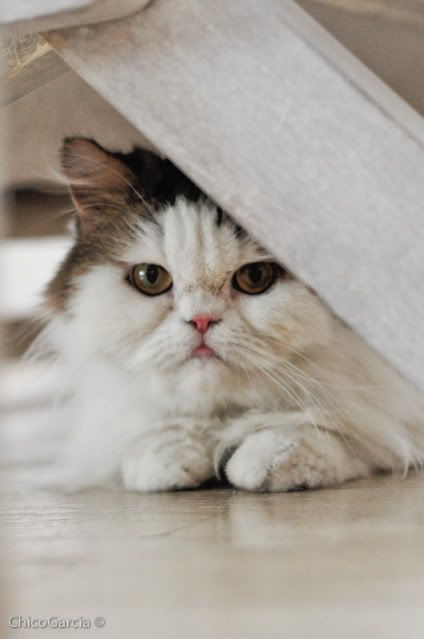
What's Under that Table?

Persian Cat Playing
Gimme That!


Persian Cat Information


Caring for Persian Cats


Persian Cat Behavior

Labels: ,

Persian Cat Behavior


Ever wondered what your Persian cat means when he narrows his eyes and looks at you? Wish you would understand what he means when he rubs against your leg? Well, I often wondered what my Persian cat meant when he narrowed his eyes, blinked and looked at me. Often, instinctively, I would also narrow my eyes, and blink back at him.

Well, reading the article that I found below helped me understand that my Persian cat was actually in a good mood when he narrowed his eyes, and blinked!

Read on for more on how to understand your Persian cat behavior.

Ginger Colored Persian Cat
Such Cute Paws!!


Cat behavior is often misunderstood because of out inability to read their body language correctly. Cats, just like us humans, use body language to communicate and broadcast information about their feelings and moods, desires, likes and dislikes. Understanding the meaning of various body signals can help you understand your cat’s behavior better, build a better relationship and even predict its behavior in the future.

Cat's feet are useful items and not just for walking and body support. For example, cat's paws knead when happy, or sometimes, if they're really nervous. Kneading goes back to when they were happily nursing close to their warm mothers. Their paws also are able to transfer their scent when they knead or rub them on things. The pads on the bottoms of their feet help to absorb the shock of landing after jumps or falls. Claws extend to attack or can extend when they need to be sharpened.

Vocalizations vary from cat to cat. Some breeds, like the Siamese, are known for being chatty, and will often "talk" to their family. Other breeds are mostly quiet. As you get to know your cat over time, you will learn what the different sounds mean. Your cat may meow when she is hungry, content, or playful. Purring generally indicates contentment. Hissing, spitting, and snarling are expressions of fear, anger, or dissatisfaction. Yowling is a cat-to-cat communication, and is often a cry of the female in heat.

Rapid blinking can show anxiety in some situation but it can also be a sign that a cat has friendly intentions and does not pose a threat to another cat. Half-closed eyes or slow blinking is generally a display of contentment. Some cat owners believe that blinking at their cat, if the blink is returned, is the feline equivalent of giving and receiving a little kiss. Like humans, large pupils (dilation) indicate interest, while smaller pupils mean that your cat isn’t very alert or attentive.

A cat that is ready to fight will try to make herself seem as large as possible. The fur along her spine will stand on end, and she may arch her back.
Her eyes will be narrowed to slits and her ears will lay flat back. Her whiskers will stretch forward.

By misreading your cat’s body language and by responding to its signals in wrong way your cat could develop certain unpleasant behavior problems, he could loose trust in you, become timid, aggressive and unpredictable. If you already have troubled relation with your cat then observing and understanding his body language can provide important information about his feelings and reasons and can be very helpful in solving your cat’s behavior problem.

Source: http://aboutpersiancats.com/aboutpersiancats_002.htm


Adorable Persian Cats Pictures

Doll Faced Persian Cat with Yellow Eyes

Smoky Doll Faced Persian Kittens

Traditional Blue Persian Cat


Persian Cat Information


Caring for Persian Cats

Labels: ,

Caring For Persian Cats


It is not easy to care for a Persian cat. So if you plan on adopting a Persian cat, take the time to study how to care for Persian cats. A pet is a life-long responsibility, but a Persian cat has its own trials.

For one, Persian cats have long fur that is very prone to matting, and must be combed on a daily basis. Persians can also sometimes suffer from watery eyes and breathing problems because of their flat faces. Their faces will need washing periodically.

They also do not like to be alone for long periods of the time, so if you are away frequently, Persian cats should not be your number one choice of pet.

Persian pets are only suitable for people who have the time to care for their long hair and give them the regular affection they need.

Please read more on how to best care for your Persian cat.

Beautiful White Persian Cat


Caring For Persian Cats
By Will Jones

Persian cats are among the most popular breeds of cat in America, today. Well known for their gentle, sweet personalities and their long hair, Persian cats are also great companions for virtually anyone, and need very little attention.

Persian cats actually come in a variety of colors. They are divided into seven color divisions: solid, silver and gold, tabby, shaded and smoke, particolor, bicolor and Himalayan. No matter what color of Persian cat it may be, they are best noticed during competitions by their long and flowing coats.

Persian cats are not great outdoor cats. Because of their long hair, if left outside for any length of time in weather, their coats can become seriously matted and damaged.

Most short-haired cats have no problem maintaining their own coats through daily self grooming, but this is not so for long-haired Persian cats. It is a good idea to brush
the cat's hair daily or as often as possible. When Persian cats is very young, it is a good idea to start bathing on a regular basis with recommended shampoos, in order to
keep the coat healthy, clean and mat-free.

Another thing that’s common with Persians cats is their eyes. Their eyes are very big and can sometimes be too much for the cat to clean. You'll notice a lot of matting of the hair around the eyes when there is a problem. This is a common health problem with the breed, and should be checked on a regular basis to ensure that it doesn’t get out of control.

The Persian breed is gentle and sweet, getting along great with everyone including kids. They have a pleasant meow and using their meow and their eyes they are able to communicate very effectively with their owners. They are very playful, loved being admired and thought they do not require a lot of attention, they do love it. As with
most cats, the majority of the time, Persian cats love to bask in the sun and show others just how beautiful they truly are.

Although most breeds can be kept indoors or outside, Persian cats should always be kept inside and only allowed to go outside of the house with supervision. Keeping them inside will help protect their coats and also keep diseases and common parasites away from them as well.

To ensure that your Persian cat stays healthy, you should always take him to the vet on an annual basis. With lots of love and a little attention to grooming, Persian cats can live as long as 20 years.

Copyright © 2007 Will Jones

Will is a retired Research Food Technologist who worked over forty years with a major Fortune 500 food company in the Midwest. Product and process development of various types of foods were Will’s expertise. Will’s interests include reading, cooking, fishing, travel and golf.

Will is also a contributing editor for http://www.best-free-help.com a FREE Informational Website Portal that is dedicated to giving people expert knowledge of real value, to help people them decide!

Article Source: http://EzineArticles.com/?expert=Will_Jones

Persian Cats - Best Pet Companion

Adorable Persian Kitten - Ginger

Bushy-Tailed Persian Cat Posing

Regal Persian Tabby Cat - Cray and White

Absolute Black Persian Cat
with Brilliant Yellow Eyes

Sleepy Eyed Persian Cat - Awwwwwwww


Persian Cat Information

Labels: ,

Persian Cats Information


Persian cats belong to the feline breed of long-haired cat. The Persian cat is one of the oldest and most popular cat breeds. Persian cats are thought to have originated from Persia (today called Iran), and that is why they are called Persian cats. Persian cats are considered one of the more beautiful looking cat breeds. But their long hair (fur) takes far more grooming time than other cat breeds.


The Origin of Persian Cat

White Persian Cat

The Persian is one of the most widely recognised and popular breeds in the world - and one of the oldest. As their name suggests, Persians originate from the country that was once Persia, now Iran, in the Middle East.

Iranian Domestic cats Experts believe that today's domestic cat is the descendent of Felis libyca, a cat that is still found in Africa and Asia. A short-haired, brown mackerel tabby, its adaptation to the environment caused many early mutations, one of which was the development of the long-haired gene. The first of these cats, the Persian, was believed to have evolved on the high, cold plateaus of the country then named Persia, hence their name.

The cats were introduced into Europe by the Phoenicians and Romans in the 1500s as highly valued items of trade. The Europeans were impressed by the Persian.s long silky coat and purposefully bred the cats to perpetuate the trait. By the 1900s the cats were being exported to the United States and since then their popularity has spread throughout the world.

The Persian is the most popular breed among the long-haired cats; others include Birman, Turkish Van, Ragdoll, Mayne Coon, Norvegian Forest Cat and the Exotic (short hair version of the Persian).

In Australia today, while Persians are still out-numbered by the short-haired breeds, they continue to be popular as both a family pet and for showing purposes.

The Persian is a medium to large cat with heavy bones and excellent balance from section to section.

Source: http://www.gorbeh.com


Persian Cat Personality

Persian Cat Walking on a Ledge
Persian Cat with Personality!

Persian cats are affectionate, easy going, docile, very adaptable, and need attention, and love to be played with. They aren't particularly demanding, but most will want to sit on your lap and be petted every day. Some develop a particular attachment to one person in the family, and will want much more time and affection from them than anyone else.

They are good with other pets, and with children. They're very adaptable, and usually cope well if changes occur such as additions to the family, new pets or a house move.

They don't like to be left alone for long periods of time, so if you're out during the day, it's better to keep them with another pet for company.

Their long fur is very prone to matting, and must be combed on a daily basis.

Like the Himalayan cat, Persians can sometimes suffer from watery eyes and breathing problems because of their flat faces. Their faces will need washing periodically.

Whilst their lovely personalities mean they make wonderful pets, they are only suitable for people who have the time to care for their long hair and give them the regular affection they need.

Source: http://www.cat-behavior-explained.com/persian-cat.html


Persian Cat Pictures

Persian Cat with Brilliant Blue Eyes

Ginger Persian Cats

Persian Tabby Cat - Yellow Eyed
Beautiful Cat Face Shape

Gray Persian Cat Resting After Lazy Afternoon Lunch


Caring for Persian Cats

Labels: